![tractivity-email-logo.png]](https://www.tractivity.co.uk/hs-fs/hubfs/Logo/tractivity-email-logo.png?width=180&height=36&name=tractivity-email-logo.png)
Enquiries and Activities are both essential tools for recording your stakeholder engagement work. But when should you use an Enquiry? What makes it different from a regular Activity? This article explains what an Enquiry is, when to use one, and how they can improve your data organisation.
Enquiries vs Activities
In a sentence:
- Enquiries act as a central folder to group all related engagements around a single topic or issue.
- Activities are individual interactions, past or future, such as emails, phone calls, meetings or site visits.
Not every engagement with a stakeholder needs an Enquiry, but when multiple interactions relate to the same topic, Enquiries can add clarity and structure.
Use Enquiries when:
- engagement relates to a specific issue, topic, or theme.
- multiple activities need to be grouped together.
- you want clear visibility and reporting on a single matter.
Examples include:
- A planning application
- A complaint or concern
- A consultation or engagement campaign
- A long-running issue with a stakeholder or group
A handy example
The below diagram shows the same information being added to Tractivity, but in two different ways.
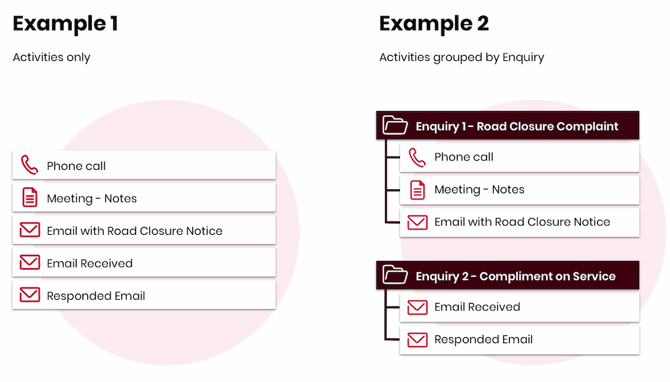
The first example only use Activities; the second example uses Enquiries and Activities.
In example one, if asked to export all the Activities that are linked to the “Road Closure” topic, you may find it difficult to do so, as the Activities are all separate from each other. In example two, the Activities are grouped under Enquiries, making it easier to export or review the Activities as a group.
If you have any questions or concerns about Enquiries, reach out to your Customer Success Manager, or email customersuccess@tractivity.co.uk.