


<img src="https://secure.leadforensics.com/85165.png" alt="" style="display:none;">
Skip to content
The single source of truth for all stakeholder management & engagement.
The complete set of features for effective stakeholder management.
Capture feedback, track issues and commitments, and analyse sentiment to improve outcomes.
Capture and answer every resident question with Publiq and Tractivity.
Your stakeholder data protected by ISO 27001, Cyber Essentials Plus, NHS DSPT and full GDPR compliance.
Design surveys and custom forms to capture stakeholder feedback.
AI-powered dashboards and 150+ pre-built reports to unlock actionable stakeholder insights.
Reach the people that matter to you with Mapolitical and Tractivity.
Our onboarding process and dedicated ongoing customer support to help you deliver impact.
Track, understand and take action on your stakeholder relationships.
Deliver a 360° engagement process online with our public Engagement Portal.
Outlook, Teams, Google Maps and more, all included in your subscription.
You’re the expert. We’re the software, and the home of stakeholder engagement.

dropdown-demo-2

Learn why leading organisations trust Tractivity.
Support patient involvement and work effectively with a wide-ranging number of stakeholders.
Build community trust and support positive outcomes across projects.

Compare your options 

Effectively manage and listen to your stakeholders and show them they are being heard.
Engage with stakeholders across projects and public consultation.

Compare your options 

Manage and build relationships with stakeholders and communities.

Compare your options 

Manage multiple clients and their projects in one centralised system with a full engagement audit trail.
Manage stakeholder engagement across regulated services, programmes and day-to-day operations.
Understand what makes your institution unique and support its growth.
Keep an audit-ready record of every stakeholder interaction, built for regulatory scrutiny.
You’re the expert. We’re the software, and the home of stakeholder engagement.

dropdown-demo-2

Learn why leading organisations trust Tractivity.
Read our customer success stories and discover how our clients are delivering impact with Tractivity.
The step-by-step guide to building an effective stakeholder engagement plan, with template.
Free guides, whitepapers, templates and more to help you deliver sustainable outcomes.
Helpful tips, guides and articles about stakeholder engagement, project management and more.
Learn how to identify, categorise and prioritise your stakeholders with our complete guide.
Empower sustainable engagement with AccountAbility's framework and Tractivity's system.
Expert webinars and videos on engagement, policy and best practice, free to watch on demand.
Understand your stakeholders' needs, interests and influence with our practical framework.
Benchmark vendors and shape your specification before your procurement goes to market.
You’re the expert. We’re the software, and the home of stakeholder engagement.

dropdown-demo-2

Learn why leading organisations trust Tractivity.
Rate your organisation across five categories in minutes and get an instant score with tailored recommendations.
Everything you need to meet Ofwat's expectations and show how customer insight shapes your delivery.
Calculate the time your team loses to manual admin into a defensible number for the board.
Your complete six-part toolkit for planning, running, and documenting your stakeholder engagement.
Understand the legal test for a fair consultation, and self-audit your consultation to see where it's vulnerable.
Explore free, practical resources for managing stakeholder engagement and delivering effective consultation.
You’re the expert. We’re the software, and the home of stakeholder engagement.
dropdown-demo-2
Learn why leading organisations trust Tractivity.
All of Tractivity's stakeholder engagement events, past and upcoming, in one place.
Look back at the talks, workshops and speakers from our Manchester event.
Explore talks and presentations from the 2025 event.
The Stakeholder Engagement Room: Live. Six monthly sessions with Rhion Jones.
View keynotes and real-world case studies from the summit.
Watch the sessions and insights from our live event.
dropdown-demo-2
Learn why leading organisations trust Tractivity.
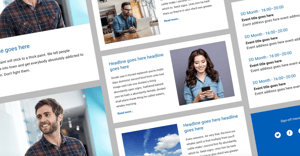
several images of stakeholders with text
Elaine Keep 16 June 2020 (Updated 07 October 2026) 6 min read

Improve Your Stakeholder Newsletters with the Right Design

Improve Your Stakeholder Newsletters with the Right Design
4:45

How can you improve your stakeholder newsletters?

It’s all about having great content, something to say, and of course, the perfect design.

With web design and email design being ever-changing disciplines, we thought we’d share some of the key concepts around improving your stakeholder newsletters to improve engagement.

How to improve stakeholder newsletters

Here are 10 steps you can follow to deliver better newsletters:

1. Plan it out

When it comes to stakeholder newsletter design, keep things clean and simple.

A sketch on paper helps you pick the key elements you need before you start creating your newsletter.

A single column of content is easier to scan and read and will scroll smoothly on mobile devices.

2. Consider your branding

Colours should be on-brand, but be mindful of how colours are linked to emotions.

Consider how your brand colours look when used for fonts, borders or other elements.

3. Welcome

Begin with a strong header.

Sitting at the very top, it should include your logo or company name, a newsletter title or image.

This will be the very first thing your audience will see when opening your email, so make sure it creates a good first impression.

4. Create a hierarchy

Create a sense of importance with colours, shapes and size of the text.

Like a newspaper, the heading should be large, with your articles broken up by subheadings.

The subheadings should be smaller than your header, but larger than the article text. This makes content easier to consume as people often skim through.

It’s okay if you only have one or two key messages for stakeholders to see. Less is more in design and if you have plenty of white space, your message will really jump out.

5. Consider a short attention span

People want to find information quickly and if they’re looking for stakeholder news, this means they want something specific from you.

Present your information clearly, saving less important information for lower down the email and try not to repeat a message over and over during the course of a series of emails.

Try and keep the message fresh, even if you are sending reminders and nudges.

6. Images

A newsletter full of text will be very boring to look at and will most likely end up in the trash. Try to choose images that engage your reader and complement your message.

Choose a landscape format, so as not to take up too much screen space. Also consider how your images will look when reduced in size, like on a mobile phone for example. The more detail in your image, the harder it will be to see what’s going on.

And try to keep your images to under 30% of the whole newsletter so it stays out of spam filters.

7. Fonts

When it comes to fonts, keep it simple. Not everyone has the same fonts installed on their computers.

That fancy new font your brand uses isn’t going to display for the vast majority of your audience and your newsletter won’t look the way you intended.

Stick to tried and tested fonts like Arial, Calibri, Times New Roman or Georgia, that are clean, uncluttered, and easy to read. Avoid novelty handwriting or cursive fonts that will make your newsletter appear unprofessional.

8. Keep it relevant, informative and valuable

Make sure your newsletter relates to the industry and focuses on issues that will be of interest.

Include content that is educational or informative and try to offer something useful.

9. Ask for what you need

A call to action is a critical part of your email newsletter and a button is a great way to get people to click through.

Whilst it’s quick and easy to link text, if it’s not clear and obvious enough, it can be a missed opportunity for a sale or a conversion.

10. Don’t forget to test!

Make sure you test your newsletter before you send it out to your hundreds or thousands of recipients.

Test how it looks in different mail clients like Outlook and Gmail. Test how it looks on different browsers like Internet Explorer and Chrome. See how it compares on different devices such as your desktop, tablet or mobile.

There may be things you don’t notice when you’re building your newsletter until you see it in your Inbox.

Streamline your stakeholder newsletter process

Tractivity has helped hundreds of stakeholder engagement and management professionals improve their newsletter communication. Our built-in email tool enables you to send branded and non-branded emails to all your stakeholder groups with ease.

Contact us to learn more about our email module and all the other communication tools we offer within a single system. 

Frequently asked questions

How do you improve stakeholder newsletters? Effective stakeholder newsletters combine great content with a clear, well-structured design. Keep layouts clean and simple; a single column works best for readability and mobile scrolling. Use strong branding, a clear content hierarchy, relevant imagery, and a prominent call to action. Always test across different email clients and devices before sending, and keep the content fresh, focused, and genuinely useful to your audience.
What should be included in the header of a stakeholder newsletter? The header sits at the very top of the newsletter and is the first thing recipients see when they open the email, so it must make a strong first impression. It should include your logo or company name and a newsletter title or image. Keep it on-brand and ensure it clearly communicates who the newsletter is from and what it represents.
How do you create a clear content hierarchy in a stakeholder newsletter? Use size, colour, and shape to create a sense of visual importance, similar to how a newspaper is laid out. The main heading should be the largest text, with subheadings smaller than the header but larger than the body text. Generous use of white space makes your key messages stand out and makes content easier to skim. One or two clear key messages per newsletter is often more effective than trying to communicate too much at once.
What are the best fonts and image practices for stakeholder newsletters? Use widely supported, clean fonts such as Arial, Calibri, Times New Roman, or Georgia; avoid novelty or cursive fonts that may not render correctly on recipients' devices. For images, choose landscape format to minimise screen space usage, ensure they remain clear when reduced to mobile size, and keep images to under 30% of the total newsletter to avoid triggering spam filters. A good balance of text and imagery makes the newsletter more engaging and more likely to be read.
How do you keep stakeholder newsletters relevant and engaging? Focus on content that is genuinely informative, educational, or useful to your stakeholder audience. Address issues relevant to their industry and interests, and avoid repeating the same message across a series of emails, even when sending reminders. Keep the message fresh. Shorter attention spans mean the most important information should be presented clearly and early, with less critical content placed lower in the email.
What is the best way to manage and send stakeholder newsletters? The most efficient approach is to use a dedicated stakeholder engagement platform with a built-in email tool, allowing you to send branded newsletters to all your stakeholder groups from the same system where your stakeholder data is stored. This means every open, click, and response can be tied back to individual stakeholder records, giving you far richer insights than a standalone email tool and keeping all communication in one centralised place.
Comments

Related Articles