



Consulting stakeholders is a two-way, controlled communication method designed to keep stakeholders engaged and satisfied, but under your terms.
Within the three levels of engagement with stakeholders, consulting sits in the middle, where the interaction with high-influence and low-interest stakeholders happens.
Consulting with Stakeholders
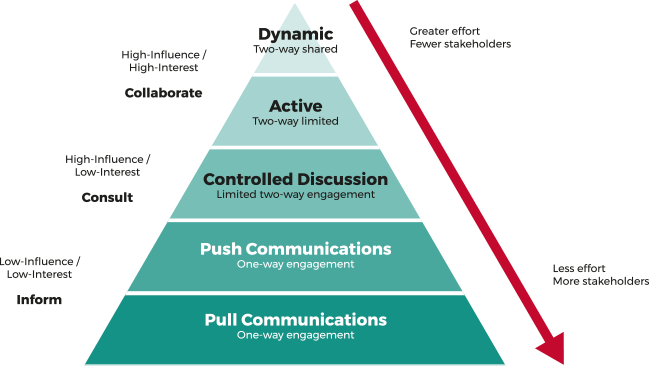
The key to effective stakeholder consultation is to control the interchange of information using digital channels and tools.
These tools are designed not only to communicate but also to isolate the conversations in narrow fields of interest that are pertinent to your project.
If you'd like to learn more about the other two levels of engagement, Inform and Collaborate, make sure to read our articles:
And now let's explore how to consult with stakeholders:
Consulting in Digital Channels
The purpose of limited two-way means of digital communication for consultation purposes is to increase the participation of your stakeholders in project affairs.
These are geared more to determining the sentiments and behavioural characteristics of your stakeholder consulting group for the purpose of learning more about them.
In other words, you are collecting data on your stakeholders to:
- get an intuitive feel for how they will react to project events;
- know when it’s time for a more personal approach.
Consulting Using Digital Surveys
Online surveys are an excellent way to focus on specific project needs and issues that you know are coming up as the project moves forward.
If you’re proactive, you’ll use surveys as a means for ideation from people outside of your inner circle.
The fresh perceptions and varying knowledge bases can feed a lot of approaches to solving problems, making processes more efficient, and breathing some new passion into the day-to-day routine.
- Control the focus of the discussion
You can make it as narrow or broad as you choose, but ensure that you’re in control of the focus of the discussion. Don’t allow for the conversation to be hijacked or waylaid by irrelevant discussions. Give clear, concise questions, multiple-choice if possible, to ensure that you get the most out of the answers. - Make it visible
A digital survey won’t be completed by every target stakeholder instantly. Make sure it’s visible and that the intent is clearly communicated. If you have a project or organisation website, host it on the main page. If you are announcing the survey to a group of stakeholders, include it in communications more than once and give enough warning for the closing date.
Consulting Using Social Media
Moderating comments on your project and corporate social media pages can be an exceptionally effective consulting practice.
However, due to the potential for a high volume of comments and the complex issues they may require responses to, beneficial comment moderation demands a highly disciplined and organised approach.
To benefit both the stakeholder and the stakeholder/project relationship, identifying conversations and eliciting correct responses needs to be done quickly and competently.
If moderated correctly, the feedback provided by social media interactions is indispensable. By improving the one-way information flow, the stakeholder is given a voice in how things could be done.
The ideation that could emerge from this exchange of information should not be underestimated. Many of these stakeholders are outside the day-to-day operation of the project and will see things from a different perspective. That perspective could be enlightening to a project team on the verge of burnout and could change the outcome of the project for the better.
- Monitor regularly
In creating a social media page, you are owning the conversations around your project. But in doing so, you’re also making the conversations around the project more visible, whether they’re positive or negative. If you don’t monitor the comments regularly, you are forgoing any advantage that this would give you for a timely response. - Don’t be put off by negativity
There’s nothing like a lively discussion to stir up interest and passion in the project. Be careful not to censor negativity by removing comment sections, or refrain from creating social media pages to avoid negative reactions. The stakeholders will be more firmly engaged and satisfied if there’s an online forum for their opinions that’s responsive and listens to what’s being said. - Start conversations
If you’re interested in hearing feedback on specific subjects, there’s no reason why you can’t start the conversation using social media. Questions demonstrate an active interest in the stakeholders and will help to build on that all-important relationship.
Ideating and Getting Feedback
When establishing a consultative relationship with your stakeholders, it’s essential to be clear and direct.
Never forget that this is a digital communication channel and your words must articulate both thought and deed clearly and precisely. The last thing you want to happen is for a stakeholder to interpret your intent in a different manner than you wanted.
The key to relationship-building is patience. It doesn’t happen overnight, and it deals in the world of intangibles such as trust, mutual respect, and understanding. They’re achieved over time. Don’t wait until there’s a problem to engage in a consulting relationship.
If all you ever do is approach your stakeholders to solve your problems, you will wear out your welcome quickly, lose respect, and never develop the level of trust you need.
Remember that these stakeholders are with you for the long haul, so you must take a long-term view of the relationship you need to build.
The digital delivery methods and tools for ideating with and getting feedback from stakeholders encompass digital tools such as email, SMS, IM, Skype, and Slack just to
name a few.
From a best practice point of view, these tools form the foundation of your consulting relationship and achieve these three objectives:
1. You dictate the nature of the consultation. You’re in control of the issue.
2. The stakeholder’s response is limited to a yes or no response with some possible discussion on modifications or clarifications to your plan but, within the context of your plan.
3. Engagement is accomplished digitally without the need for face-to-face meetings and the associated delays that would impose on getting the help needed now.
Look at your limited two-way consulting communication channels as a risk management effort and open your eyes to ideas and problems that would otherwise slip through the cracks.
Best Communication Tools to Consult with Stakeholders
Connecting with high-influence stakeholders using digital tools makes the consulting process easier than relying on traditional methods.
Digital channels bring great power to engage with stakeholders, and at a minimal cost.
Savvy organisations choose cloud collaboration software that offers all the tools and features to support good relationships and track all data.
The primary benefit of using digital channels in accomplishing stakeholder consultation is that it makes work simpler and faster.
Tractivity is streamlining stakeholder collaboration for many organisations in the public and private sectors.
Contact us to learn more about how we can help you improve the way you collaborate with your stakeholders.