


During Tractivity’s 2025 Stakeholder Engagement Day, I gave a presentation on Next-generation stakeholder management - how a changing world demands so much more.
This is the second of three articles exploring the themes I raised in that session. You can find the first part here, and the last one here.
The shifting landscape of stakeholder communication
Modern communications practices have long been adopted by most public or private organisations of any size or status.
They come in a variety of Codes of Practice, Best Practice Standards or Industry-approved Guidance, and many include a familiar list. These are honesty, integrity, truth-telling, transparency and so forth. Members of the Public Relations Consultants Association (PRCA) have to observe a Code of Conduct, and those registered for political or Parliamentary lobbying are bound by The Public Affairs Code.
These are mainly concerned with relationships and the need to be open and transparent about them. Seeking to influence Ministers, civil servants, members of parliament, and a host of other public or industry bodies is legitimate but has to be reported. Since the 2014 Transparency of Lobbying, etc. Act, organisations that actively undertake these roles must be on the Register of Consultant Lobbyists.
Navigating truth in a more complex information environment
None of this covers what you can say or how you say it. It is, of course, implicit in any framework that requires honesty that one must tell the truth, but even that has become a contested space in an age of ‘alternative truths’ and misinformation.
If anyone doubts the complexity of truth-telling, we have just experienced a marvellous case study in the BBC’s editing of Donald Trump’s 6th January remarks that preceded the assault on the Capitol.
Why one message no longer fits all stakeholders
Stakeholder communication is now becoming an interesting challenge as the days of one-size-fits-all mass (e)mailings are over, and everything is personalised.
Clearly, if you are effectively ‘managing’ 50-100 stakeholders, it is quite a different proposition from those with thousands of potential interfaces. Smaller-scale networks do not necessarily mean less complex messaging, but they do afford the luxury of enabling a wider range of communication methods.
I remember once being told by a senior local government officer why local authorities in England took longer to grasp some government messages than their counterparts in Scotland. You could, he explained, get 90% of the Council Chief Executives in Scotland in a single room at three days’ notice. At the time, there were about 350 local authorities in England, and the task was impossible!
Cutting through the noise in high-volume environments
Today, we rely on digital communication, and AI will accelerate the trend. The problem is the sheer amount of messages that managers routinely receive. Information overload has been well researched by academics and others, so we know that cutting through the ‘noise’ to reach someone you may regard as a ‘key stakeholder’ requires skill, tact and maybe some patience.
Bombarding busy people with unsolicited messages, no matter how imaginatively crafted, merely antagonises them. It has become a classic case of less=more, so a good starting point may be to be single-minded in thinking about the nature of the information that you need to pass between you and your stakeholders. That, of course, in turn should just be a reflection of the relationship as a whole, and why they are a stakeholder.
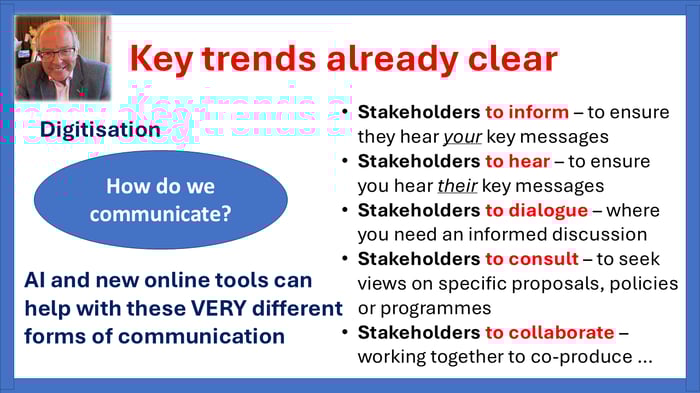
With this in mind, whilst exploring ‘next generation stakeholder management’, I invited the Tractivity audience to consider five different categories of stakeholders in terms of what’s needed of the communications dynamic:
View Rhion's full presentation and presentations from our other speakers.
Understanding the five core communication dynamics
- There are stakeholders we feel it is important to inform
Maybe you need them to know of developments that might affect the relationship; new services you provide, policy changes or initiatives that might affect them, and ignorance of which might cause them pain or loss. A regulator, for example, would be in serious breach of its raison d’etre if it did not effectively explain changes to those who are affected, and that list might be wider than you expect. - Next are the stakeholders you need to hear from
Without their input, you run the risk of making serious mistakes or failing to pick up important intelligence. It helps if they are equally eager to inform you, but this does not necessarily hold. It may well be that although their insight may matter to you, it might not to them, and in such cases, you need to devise an incentive to encourage their participation. - The third category includes stakeholders with whom you need to dialogue
It might be that you share a mutual interest, like two Councils sharing a common border and needing to agree on mutual service provision. Or you might share a common or problematic third-party relationship – even an adversary of some sort - and where an exchange of views helps both sides handle threats and opportunities. Here, it is hoped that the logic of the situation stimulates a mutual desire to communicate and, ideally, establish appropriate machinery for the dialogue. - There are stakeholders you may need to consult
Whilst this could be a continuous commitment – possibly because of a legislative, regulatory or even constitutional requirement – the more challenging situation is where you have proposals that may affect your stakeholders, and where you are uncertain of the likely impacts. Here, you absolutely need to engage with such consultees and ensure they understand your position and respond honestly. It is an open secret that one of the frustrations of those seeking to reform the planning systems in the various UK jurisdictions has been the delays caused by the failure of ‘statutory consultees’ to respond to planning applications, etc., in a timely fashion. Legislation only partly addresses the problem, which is more about the lack of resources.
- Finally, there are stakeholders with whom you need to collaborate
Many organisations, of course, have joint projects and have bilateral, operational arrangements which work well enough on a day-to-day basis. But the stakeholder relationship is different. Is it essentially a tactical, transactional or temporary collaboration? Or is it a more strategic partnership involving a degree of skills and knowledge sharing, the pursuit of commercial or political opportunities or a pooling of resources? Co-production initiatives, for example, may require a voluntary agreement to share responsibility and accountability with legal and reputational implications.
These are not, of course, mutually exclusive. It is perfectly possible to have a stakeholder with whom you need to engage on several levels.
But it may be worthwhile to ask oneself what the primary, or currently, the most compelling goal your communication needs to achieve.
Making informed choices about how to engage
All these call for different ways to communicate. Even routine announcements or updates need to take into account your relationship priorities, and it is fortunate that modern systems can help define the kind of messaging that is most appropriate.
At the Tractivity Stakeholder Engagement Event, there was much discussion of the extent to which AI can assist in this new age of more targeted communications requirements.
These will emerge, no doubt, with a fair amount of trial and error. But the fundamentals remain, and it is for Stakeholder Managers to rigorously assess the business needs for each relationship and find the best ways to engage.