



Stakeholder collaboration is the highest level of engagement, a continuous, two-way partnership with high-influence, high-interest stakeholders in which decisions and outcomes are co-created rather than simply consulted on. It involves fewer stakeholders than lower engagement tiers but demands significantly more effort and structure - and the right platform to hold it together.
This guide covers who qualifies for collaboration, how to build the process, and how to secure buy-in from busy, senior stakeholders.
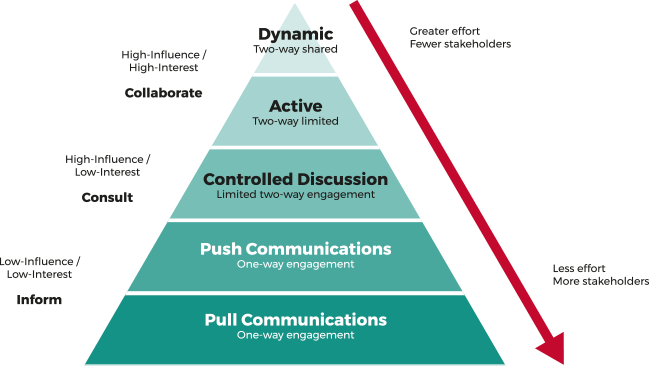
Stakeholder collaboration in the communication pyramid
Once you have identified, categorised your stakeholders and planned your communication to inform and consult with stakeholders, it's time to move to the Dynamic level of communication.
Stakeholder collaboration is an unrestricted two-way exchange of information and insight. It demands greater effort but involves fewer stakeholders than the lower tiers of engagement. At this stage, dialogue replaces updates, and decisions are shaped together.
Why stakeholder collaboration matters
Collaboration improves project delivery by surfacing risks earlier, strengthening legitimacy, and accelerating decisions.
Guidance such as the Cabinet Office Consultation Principles encourages meaningful engagement, transparency, and shared accountability. Collaboration builds on this foundation, moving from simply seeking views to sharing responsibility.
Projects that prioritise collaboration see measurable improvements in trust, decision-making speed, and stakeholder satisfaction. By involving the right people early, risks are identified faster, resistance is reduced, and delivery becomes more resilient.
Who should you collaborate with?
This collaboration process involves the high-interest/high-influence stakeholders of your project.
These are your key stakeholders. Due to their position and experience, they possess a wealth of knowledge, expertise, and influence within the project's sphere. They can act as advocates, helping to garner support from other stakeholders and key decision-makers.
Their involvement lends credibility and legitimacy to the project, facilitating smoother implementation and overcoming potential obstacles.
Examples include:
- Senior decision-makers, executives, or project sponsors;
- Regulatory bodies or statutory authorities;
- Elected officials, councillors, or community representatives;
- Major delivery partners or consultants with specialist expertise.
Your collaboration with stakeholders that belong to the Dynamic engagement level must happen on a continuous basis, with shared responsibility for the health of the project.
How to create a stakeholder collaboration process
Due to their influential positions and extensive expertise, it is crucial for these stakeholders to actively contribute to the everyday running of your project.
Successful collaboration depends on access, transparency, and shared accountability.
For it to work, stakeholders need the right tools and structure that facilitates this collaboration.
1. Provide access to project information
All collaborators should have access to reports, meeting notes, and live documentation.
If you use the Google G-Suite as your cloud repository, stakeholders must be able to access Google Docs, Sheets, Forms, and Calendar. If you use a tool like SharePoint as your cloud infrastructure, they must have an email account that gives them access to your project's current files and archives.
Using a stakeholder management platform ensures everyone can view current data and decisions in real time.
2. Co-author processes and documents
Encourage stakeholders to contribute directly to reports, plans, and frameworks.
Take advantage of their unique value to your project; they wouldn’t be high-power stakeholders if they didn’t have that kind of value.
3. Involve stakeholders in decision-making
Collaboration goes beyond gathering input; it means shared decisions.
Set up steering groups or working sessions where stakeholders play an active role in shaping strategy, priorities, and actions
4. Keep collaboration visible and traceable
They must be accessible on your stakeholder management tool and recognised by name in the project communication plan in both the stakeholder management section and the project team section.
Within Tractivity, you can tag collaborators, log interactions, and generate reports showing how stakeholder input has shaped decisions.
By including these influential stakeholders in the collaboration process, you tap into a powerful network of support, expertise, and resources, enhancing the project's overall chances of success.
How to get stakeholders to agree on collaborating
Stakeholder collaboration presents several challenges. Busy schedules limit availability; geographical distances complicate coordination, and differing financial incentives can create conflicts of interest or reduce motivation to participate.
To gain buy-in, stakeholders must understand why their involvement matters and what value it brings.
- Show impact: Illustrate how their contribution influences project outcomes and public benefit;
- Make participation simple: Offer flexible, digital collaboration options;
- Demonstrate value: Highlight how involvement supports their goals - reputation, influence, or efficiency;
- Maintain communication: Keep dialogue active with visible results from their input.
Learn how Tractivity’s engagement portal simplifies collaboration
By addressing their concerns, providing continuous communication channels, and involving them in decision-making processes, stakeholders are more likely to buy into the collaboration process and contribute to the project's overall success.
Collaborating with stakeholders using digital tools
Connecting with high-power stakeholders using digital tools makes the collaborative process much quicker and easier than relying on traditional methods - not to mention they can be more likely to engage with you if you are able to provide a good engagement experience.
The time saved for you can be reinvested into keeping the project moving forward, while the proactive and dynamic digital collaboration keeps stakeholder concerns from slipping through the cracks.
Digital channels bring great power to collaboration with stakeholders at a minimal cost.
A good digital collaboration platform should:
- Centralise communications, feedback, and documents;
- Allow real-time visibility of actions and updates;
- Track decisions and progress;
- Integrate surveys, events, and reporting in one place.
Savvy organisations choose cloud collaboration software that offers all the tools and features to support good relationships and track all data.
Conclusion
Collaboration is the point where stakeholder engagement becomes partnership.
By identifying your high-influence, high-interest stakeholders and creating a structured, transparent process, you build stronger, lasting relationships.
The primary benefit of using digital channels in accomplishing stakeholder collaboration is that it makes work simpler and faster.
Tractivity is streamlining stakeholder collaboration for many organisations in the public and private sectors. Contact us to learn more about how we can help you improve the way you collaborate with your stakeholders.