


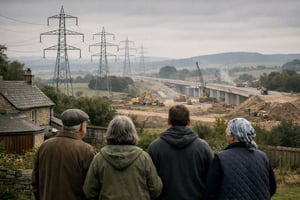
'Stakeholder atmospherics'
I was recently asked to consider the challenge of community dialogue once major infrastructure projects get to the stage we call “shovels in the ground”.
Usually, it follows years of extensive and soul-searching controversy, planning inquiries or even legal challenges. Although there are benign projects that are welcomed by local people, there are often disadvantages, both temporary and permanent.
Affected communities include people exhibiting sullen, reluctant acquiescence, as well as those who are still campaigning against. Many will still not be reconciled to the idea that their village or landscape will be changed forever.
A century of organised opposition
The UK has some formidable campaigning groups with years of experience in trying to influence planning policy.
Exactly one hundred years ago, the Campaign for the Protection of Rural England (now CPRE) was founded to prevent over-development and less socially acceptable land use. It has had an enormous influence and claims credit for the green belt concept. Scarcely a single planning document from central or local government will escape scrutiny from the CPRE, which, alongside the Royal Society for the Protection of Birds (RSPB) and the National Trust, can mobilise public opinion very effectively.
These three organisations have masterminded opposition to many ambitious programmes or projects. In the 1980s and 1990s, two high-profile road by-passes at Winchester (Twyford Down) and Newbury prompted nationwide debate and controversy. Although both were ultimately built, they obliged transport planners and highway engineers to rethink their approach, and taught Governments that they needed to win the argument for public opinion. Close by, these battles are still being fought, alongside the Stonehenge monument on the A303.
Friends of the Earth (FOE), which often makes common cause with the other three, has a different history, having begun as a more political movement in the USA and focused on ecological sustainability. This has morphed into an international campaign for climate activism, taking on Governments, local authorities and big business when it feels that the environment is under threat. It is often coupled with Greenpeace, which began in Canada around the same time in 1970, and has become synonymous with high-profile direct action and media campaigning.
What all these do so well is to deliver complex arguments in ways that appeal to a broad spectrum of citizens. Social media has been wonderful for them. They have succeeded in ‘framing’ each contentious question in ways that have consistently wrong-footed public bodies and property developers.
The 'contaminated air': what stakeholder teams inherit
They may not always prevent projects from happening, but they clearly affect the climate of opinion surrounding the issue.
The challenge for those who are building lies not just in forging and nurturing reasonable relationships with local people, but in overcoming years of mistrust when professional opponents have convinced them that they had the better of the argument. In other words, today’s stakeholder management dynamic is affected by the nature of what took place in previous years.
It has been said that ‘shovels in the ground’ must be accompanied by ‘dialogue in the air’ as those who construct have to engage with those whose lives they affect. What causes concern, to stretch the analogy, is that the surrounding ‘air’ has been contaminated by the flavour(s) of the past. These ‘atmospherics’ have not always been sweetness and light; at the extreme, they have poisoned the well of interaction and debate.
The very first step for any project construction team, therefore, has to be to ‘take the air’. Or maybe measure the ‘air quality’? Understand what lies within the inherited atmosphere. As in real life, there are harmless substances which need not cause any concern, but there may also be poisonous elements which need to be removed. Any such health check needs to be undertaken by experts and sufficiently independent to withstand any criticism from vested interests. For major, contested projects, it is unlikely that the prevailing situation is problem-free.
The analogy need go no further.
When we implement key decisions, be they bricks and mortar or complex administrative policy, there comes a point when someone has to contemplate a longer relationship with important stakeholders and where the history matters. If, as well illustrated by the UK’s recent experience of transport or energy projects, Ministers have forced through decisions despite the passionate objections of respected environmental groups, it is not surprising that there is a need to invest heavily in rebuilding trust and finding areas of consensus.
Tools for rebuilding trust
The Government’s adoption of potentially generous ‘community benefit’ schemes is one of several tools needed to heal some of the wounds from successive battles over unpopular schemes. It comes about twenty years too late. Another is the creation of effective and accountable Stakeholder Reference Groups and other machinery to help co-produce appropriate aspects instead of being given an already-designed fait accompli. A third requirement is to use modern online dialogue platforms to provide a serious messaging process instead of relying on Facebook or similar methods of communication so easily hijacked by divisive interests.
From tactical to strategic: building lasting relationships
Apart from assessing the atmospherics and taking steps to heal the wounds, it’s necessary to build even longer-lasting permanent relationships. There are challenges, if only because the role played by the oppositional coalitions is essentially transactional. CPRE, FoE, and the others are primarily interested in policy and its application. Of course, the specific location is of interest, but it is basically just the latest focal point for pursuing their broader cause. In time, the campaigners move on.
The transition from short-term tactical to long-term strategic relationships is often a matter of stability. This implies a continuity of personnel; minimum turnover enables people to build a rapport with each other and create areas of confidence.
It means few surprises and sufficient congruence of expectations that those representing one side can predict the reaction of the other to foreseeable events. It is this that enables them to anticipate and assess difficult occurrences and attempt to find ways to mollify the impact for stakeholders. This is as true when construction companies have to make unexpected changes to their plans as when policymakers encounter unexpected problems and need stakeholder co-operation to address the issues.
The overhanging atmospherics affect all these actions and will influence the overall perception of a project as well as its practical implementation.
Stakeholder Managers play a critical role in this and, fortunately, have a growing range of skills and capabilities to deploy.
Frequently asked questions
The accumulated climate of opinion surrounding a project built up through years of planning controversy, legal challenges, and organised opposition. Construction teams inherit this climate regardless of whether they created it, and it shapes how communities respond to every engagement that follows.