



What should a Stakeholder Engagement Plan include?
Quick answer
A stakeholder engagement plan should include twelve sections: areas of influence, regulatory requirements, methodology, stakeholder mapping, engagement activities, an engagement matrix, a timetable, resources and responsibilities, grievance management, monitoring and reporting, budget, and an annex. Each section builds on the last to give you a plan that holds up under scrutiny from regulators, communities, and project teams alike.
Most stakeholder engagement plans fail not because the engagement was bad, but because the plan was never structured to survive the project. Phases run long, teams change, regulators ask questions, and a loose document put together at the start does not hold up. This guide walks through all twelve sections of a comprehensive stakeholder engagement plan, written for organisations running complex, multi-stakeholder projects in regulated sectors.
A comprehensive stakeholder engagement plan covers twelve sections:
- Areas of influence of the project
- Regulations and requirements
- Methodology
- Stakeholder mapping
- Stakeholder engagement activities
- Stakeholder engagement plan matrix
- Timetable
- Resources and responsibilities
- Grievance management
- Monitoring and reporting
- Budget
- Annexe
1. Areas of influence for the project
Before you can plan who to engage, you need to define where your project reaches. For infrastructure and utility programmes, this means mapping both the physical footprint and the communities, landowners, and local authorities that fall within it.
A simple four-zone model works well for most projects:
-
Zone 1 (Major): Stakeholders with daily or near-daily interaction with the project. These require the most intensive, ongoing engagement.
-
Zone 2 (Moderate): Stakeholders affected frequently but not continuously, typically those within the broader project corridor or catchment area.
-
Zone 3 (Minor): Stakeholders with limited contact, often restricted to a specific phase such as construction or commissioning.
-
Zone 4 (Negligible): Those with incidental or occasional contact, or where impacts are minimal.
Organisations like Severn Trent and Anglian Water, managing multi-year capital programmes, use this zoning approach to allocate engagement resource proportionally across thousands of touchpoints, ensuring high-priority communities receive consistent attention while lower-risk groups are not overlooked.
2. Regulations and requirements
This section documents the legal and regulatory landscape your engagement must comply with. Getting this wrong does not just create reputational risk. For regulated organisations, it can affect price review outcomes, planning consent, and licence conditions.
For most organisations operating in the UK's regulated sectors, this will include:
Internal requirements:- Code of business conduct and ethics
- Anti-bribery and corruption policies
- GDPR and data privacy obligations
- Risk management framework
External requirements:
- Ofwat consumer and stakeholder engagement requirements (for water companies, including AMP reporting expectations)
- Ofgem stakeholder engagement obligations (for energy networks, including RIIO framework requirements)
- Planning Act 2008 and Development Consent Order requirements (for nationally significant infrastructure projects)
- Infrastructure Planning (Environmental Impact Assessment) Regulations
- Gunning Principles for public consultation
- Local planning authority requirements
- GDPR and UK data protection law
- Equalities Act 2010 (ensuring engagement reaches all communities, including protected characteristics)
This section should be a live reference, updated as regulatory guidance evolves. Ofwat's expectations around customer and stakeholder engagement have become progressively more detailed across each Asset Management Period, and organisations that can evidence a structured, documented approach are better placed at price review.
3. Methodology
The methodology section sets out how you will identify, categorise, and engage your stakeholders systematically. It should be specific enough that a new team member could pick it up mid-project and understand exactly how decisions are being made.
This typically includes:
-
How stakeholders are identified: desk research, consultation databases, planning registers, political mapping tools
-
How issues are categorised: economic impacts, environmental concerns, health and safety, social and community effects, service disruption
-
How vulnerable groups are identified and given appropriate weight in engagement planning
-
How engagement records are logged and made audit-ready
For organisations managing large programmes, a stakeholder management system is the most reliable way to apply a consistent methodology across projects and teams. Ad hoc approaches using spreadsheets and email create gaps in the record that are difficult to close retrospectively, particularly when regulators or planning inspectors request evidence of how engagement has been conducted.
4. Stakeholder mapping
Stakeholder mapping translates your stakeholder identification work into a visual picture of who matters most and why. It is not just a list. A proper map plots stakeholders by influence and interest, so your team can see at a glance where to concentrate resource.
This section of the plan should include:
-
A stakeholder register capturing names, organisations, locations, affiliations, and contact preferences
-
An influence/interest matrix showing each stakeholder's position
-
Any additional attributes relevant to your project: sentiment, attitude to the project, historical engagement, political affiliation
-
Groupings that allow you to plan communications at scale rather than individually
The most important thing a stakeholder map does is force the question: do we actually understand these people? Organisations that go into a planning consultation having mapped stakeholders superficially tend to be caught out by objections that a proper mapping exercise would have surfaced early.
5. Stakeholder engagement activities
This is where the plan moves from analysis into action. It sets out exactly what engagement will take place, with whom, and through which channels.
For each stakeholder group, this section should define:
-
The engagement objectives for that group
-
The methods to be used: one-to-one meetings, community events, online consultations, surveys, newsletters, and site visits
-
The channels: email, written correspondence, telephone, in-person, and digital platforms
-
Who is responsible for delivering the engagement
-
How feedback and responses will be recorded and acted on
The engagement mix will vary significantly by stakeholder tier. High-influence stakeholders such as local authority leaders, regulators, or major landowners typically require individual engagement plans. Community groups and general public stakeholders are more efficiently engaged through structured consultation events and digital channels, with a clear mechanism for capturing and recording responses.
6. Stakeholder engagement plan matrix
The engagement matrix is the operational heart of the plan. It brings together your stakeholder list, the engagement activities, and the timetable in a single view that the delivery team can work from day to day.
A well-constructed matrix shows:
-
Each stakeholder or stakeholder group
-
Their influence and interest rating
-
The engagement method and channel assigned to them
-
Frequency of engagement
-
Responsible team member
-
Status of engagement at any given point
Here is an example of a stakeholder engagement matrix: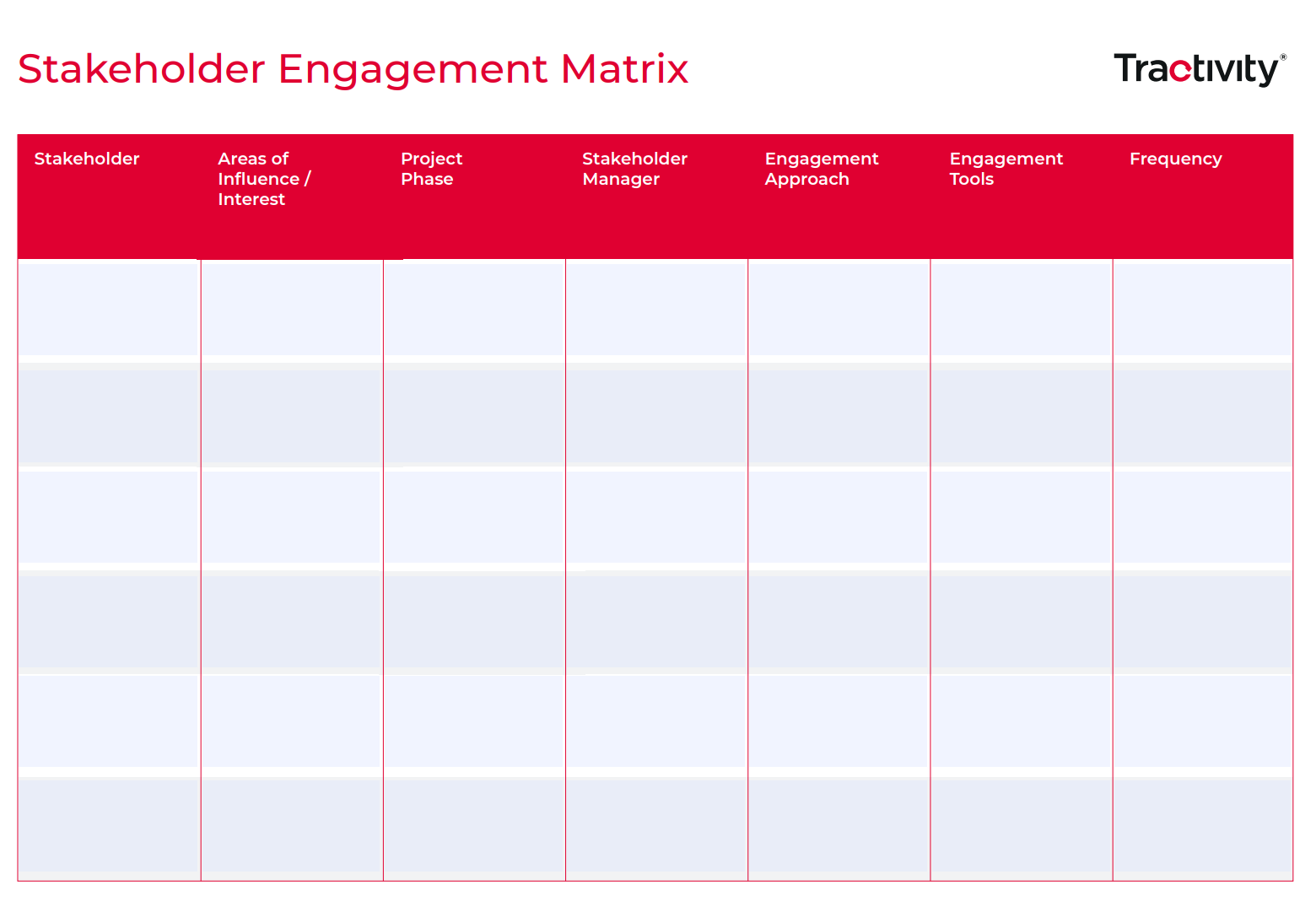
This is the document that gets updated throughout the life of the project. It is also what regulators and planning inspectors tend to ask for when they want evidence that engagement has been managed systematically rather than reactively.
Tractivity provides a downloadable stakeholder engagement matrix template you can use as a starting point.
7. Timetable
Stakeholder engagement needs to map to the project lifecycle, not run in parallel with it. The timetable section makes that connection explicit.
It should show:
-
The key project phases and milestones
-
The engagement activities planned for each phase
-
Any statutory consultation windows or regulatory reporting deadlines
-
Review points where the engagement plan itself will be assessed and updated
For long infrastructure programmes such as AMP delivery cycles or nationally significant infrastructure projects, the timetable should also build in engagement ramp-up periods before major phases begin. Communities that feel informed in advance of disruption or change are significantly more receptive than those that are only contacted after decisions have been made.
8. Resources and responsibilities
This section is often underspecified, which is one of the reasons engagement plans break down in delivery. It should name who is responsible for what, with enough clarity that accountability is unambiguous.
It should cover:
-
The internal team responsible for delivering engagement, including named leads where possible
-
Any external consultants, agencies, or communications partners
-
Technology and systems in use, including the stakeholder management platform
-
Governance arrangements: who signs off on engagement decisions, who escalates issues
-
How will capacity be managed if the project scales or team members change
9. Grievance management
Every significant project generates complaints, objections, and grievances. A good engagement plan does not try to prevent this. It sets out a clear, fair, and documented process for handling it.
The grievance management section should define:
-
How grievances are received: in writing, by phone, via an online portal, at community events
-
How they are logged and assigned for response
-
Target response times
-
Escalation routes for unresolved or complex cases
-
How the outcome of each grievance is recorded and communicated back to the stakeholder
For regulated organisations, grievance handling is not just good practice. Ofwat and Ofgem both expect to see evidence that stakeholder concerns have been taken seriously and responded to in a structured way. A grievance log that shows volume, type, response time, and resolution rate is a straightforward piece of evidence to produce if the underlying data has been captured properly from the start.
10. Monitoring and reporting
A stakeholder engagement plan is only as good as the organisation's ability to track whether it is being delivered and what it is achieving. This section sets out how performance will be measured.
Monitoring and reporting should cover:
-
The metrics being tracked: number of engagements, stakeholder reach, response rates, sentiment trends, grievances raised and resolved
-
Reporting frequency: internally to project leads, upward to leadership, externally to regulators
-
How the data is being captured and who is responsible for maintaining it
-
How findings will feed back into the engagement plan
Organisations such as UK Power Networks, Northern Gas Networks, and SP Energy Networks use Tractivity to generate engagement reports that feed directly into their regulatory submissions. Having a centralised system means the data is already structured for reporting rather than having to be compiled from disparate sources at the end of a reporting period.
11. Budget
Engagement costs time and money, and both need to be planned for explicitly. A budget section that is vague or absent is a signal that the engagement has not been thought through seriously.
The budget should include:
-
Staff time allocated to engagement delivery
-
External agency or consultancy costs
-
Event and venue costs
-
Technology and platform costs, including stakeholder management software
-
Printing, communications, and materials
-
A contingency line for unplanned engagement needs that arise during delivery
12. Annexe
The annexe collects supporting material that sits behind the main plan: detailed stakeholder lists, completed matrices, evidence of past engagement, mapping outputs, correspondence logs, and any technical or legal documents referenced in the plan.
It is also where you would include:
-
Any equality impact assessments relating to the engagement approach
-
Copies of regulatory guidance documents with which the plan has been designed to comply
-
Version history if the plan has been revised during the project lifecycle
Key takeaways
-
A stakeholder engagement plan should cover twelve sections, from areas of influence through to budget and annexe.
- The regulations and requirements section needs to reflect the actual frameworks that apply to your sector. For UK water and energy companies, that means Ofwat and Ofgem obligations, not generic international standards.
- The engagement matrix is the working document your team will use day to day. Keep it live.
- Grievance management and monitoring are the sections most likely to be scrutinised by regulators. Build them properly from the start.
- A stakeholder management system makes the difference between a plan that looks good on paper and one that is actually delivered and evidenced.
Download Tractivity's free stakeholder engagement plan template, including a ready-to-use engagement matrix, and get started properly:

Why do organisations need a stakeholder engagement plan?
Because stakeholders don't wait to be managed. They form opinions, raise objections, and if they feel ignored, organise opposition. Getting ahead of that requires a plan.
Without one, projects routinely miss affected communities, fail to meet consultation requirements, and find themselves stalled by resistance that could have been anticipated months earlier. The organisations that handle this well don't just avoid problems — they actively build the kind of trust that makes complex projects possible in the first place.
A solid stakeholder engagement plan helps you to:
- Identify everyone affected before issues surface, not after
- Demonstrate compliance to regulators, auditors, and funders
- Build genuine trust with communities, government bodies, and other key groups
- Maintain a clear audit trail of all engagement activity
- Keep large, distributed teams coordinated without relying on overflowing inboxes and unwieldy spreadsheets
In short, it's the difference between a project that runs and one that doesn't, and avoids the risk of project failures.
Who needs a stakeholder engagement plan?
Honestly? Most organisations running any project with an impact on people, communities, or the environment. That's a broader group than many assume.
It's obviously critical in regulated sectors — energy, transport, utilities, infrastructure, healthcare, government — where formal consultation and evidence of engagement is often a legal or contractual requirement. But a local housing development, a service redesign in the NHS, or a new infrastructure scheme all carry the same fundamental need: to understand who's affected, engage them properly, and be able to show that you did.
The scale of the plan should match the scale of the impact. A major infrastructure programme needs something comprehensive. A smaller project needs something proportionate. Neither needs anything.
How is a stakeholder engagement plan different from a communications plan?
A communications plan is about what you say, to whom, and how. A stakeholder engagement plan is considerably more ambitious than that.
It starts further back — identifying who your stakeholders actually are, understanding their interests and concerns, assessing their influence — and it goes further forward, covering grievance management, ongoing monitoring, and producing the kind of documented evidence that regulators actually want to see.
The key distinction is the direction of travel. A communications plan pushes information out. A stakeholder engagement plan creates a genuine two-way process — one where stakeholder feedback shapes decisions, concerns are logged and addressed, and the whole thing is properly evidenced.
In regulated industries, that difference is not subtle. Regulators want proof of genuine engagement, not proof that you sent some emails.
How Tractivity supports stakeholder engagement planning
Tractivity is a stakeholder management platform used by regulated organisations across water, energy, transport, and the public sector to plan, deliver, and evidence stakeholder engagement. It centralises stakeholder records, engagement history, and communications in one place, and generates the reports organisations need for regulatory submissions and internal governance.
Clients including Severn Trent, Anglian Water, Northumbrian Water, UK Power Networks, SGN, SP Energy Networks, Electricity North West, and Northern Gas Networks use Tractivity to manage engagement across large-scale capital programmes and regulatory reporting cycles.