


The part of the programme the public actually sees
Engage-360 is Tractivity's public-facing engagement portal: the documents, the comment form, the register people join, and the responses they get back. It's a separately priced module, and it doesn't replace a single notice you're legally required to serve.

What the Engage-360 portal does
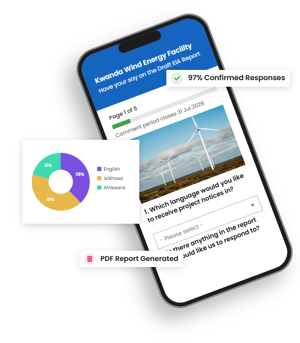
Engage-360 carries your branding and sits on your domain, so it reads as the proponent's or the municipality's process rather than as a software product. Everything it collects lands in the same register the rest of the programme runs on, which is the point of it: the comment, the person who made it and the response that went back are one record, not three systems.
Four things it does in a South African process
Publishes the documents
Background Information Document, scoping report, environmental impact assessment report, draft IDP or budget, whatever the process puts out for comment, with version history so it is clear what was available when.
Takes comments online
Each comment lands against the person or organisation that made it, in the same register that the rest of the programme runs on, with the date and time it arrived.
Lets people register themselves
Self-registration puts someone on the register of interested and affected parties, which Regulation 42 recognises as one of the routes onto it: everyone who requests registration in writing.
Publishes the responses back
The comments and responses report goes back out through the portal. It is the step most processes do worst, and the one a review looks at hardest.
Where it fits the statutory process
- Regulation 40 gives all potential and registered interested and affected parties a minimum of 30 days to comment on submitted reports. The portal is a route for those comments and a timestamped record of when each one arrived.
- Regulation 42 requires the register to hold everyone who commented or attended, and everyone who requested registration in writing. Self-registration and online comments both write to that register directly, so it is current rather than reconstructed at the end.
- Regulation 44 requires written comments, responses and records of meetings to be attached to the reports submitted to the competent authority. The comments and responses report is produced from the same data the portal collected, not assembled from it afterwards.
- Section 17 of the Municipal Systems Act requires mechanisms for receiving, processing and considering petitions and complaints, for public comment, and for report back. The portal is one such mechanism, and report back is the part it does that email does not.
What the engagement portal does not do
Regulation 41 requires a site notice of at least 60 centimetres by 42, a newspaper advert, and written notice to occupiers, the owner, adjacent owners and occupiers, the ward councillor, any ratepayers' organisation, the municipality and any organ of state with jurisdiction. A portal discharges none of that.
Under the National Water Act, the water use licence regulations require the same pattern of physical and press notice. The portal is where the process is recorded and where people who are online can take part. It is not a substitute for the notice, and a supplier who implies otherwise is advising you into a review.
The public participation process page sets out how the physical steps and the online ones are held as one record.
Access, language and the cost of data
A portal that assumes a fast connection and an uncapped data bundle excludes the people a participation process most needs to reach, and in South Africa that exclusion is not only bad practice. Section 17 of the Municipal Systems Act requires mechanisms that account for people who cannot read or write, people with disabilities, women and other disadvantaged groups. Regulation 41 requires alternative methods agreed with the competent authority where there is illiteracy, disability or disadvantage.
What that means for configuration: keep pages light, keep documents downloadable rather than only viewable, and do not gate a comment form behind an account where a comment can be taken without one.
On language, the platform interface is English. What South African law requires is multilingual output: section 18 of the Municipal Systems Act requires communication in the official languages the council determines by reference to local preference and usage, and section 4 of the Use of Official Languages Act requires national departments, public entities and public enterprises to adopt a policy naming at least three. Documents, notices and comment forms published through the portal can be published in more than one language. Be precise about that distinction in a tender, because the two are routinely conflated and only one of them is something we can deliver.
How Engage-360 is priced
Engage-360 is a separately priced module; it is not part of the £9,495 base licence. The module is configured and quoted against the scale of your engagement programme, the branding and customisation you need, and the integration scope.
Everything in the base licence works without it: the register, surveys, communications, grievances, commitments and the 150+ reports.

Engage-360, answered
No. Engage-360 is a separately priced module, configured and quoted against the scale of the programme. The base licence works without it.
No. The site notice, the newspaper advert and the written notices to owners, occupiers, the ward councillor and organs of state are all still required. The portal records the process and takes online comment.
Yes. Regulation 42 recognises a written request to be registered as one of the routes onto the register, and self registration writes straight to it.
Yes, and it is generated from the comments the register already holds rather than assembled by hand at the end of the process.
The interface is English. Documents, notices and comment forms published through the portal can be published in more than one language, which is what section 18 of the Municipal Systems Act and section 4 of the Use of Official Languages Act actually require.
It can be configured to. Keep pages light, keep documents downloadable and do not require an account before someone can comment.
Yes. A comment made online is held against the same person or organisation record as a comment made at a public meeting, so the register is one list rather than two.
Yes. It carries your branding and sits on your domain, so the process reads as yours rather than as a supplier's product.
Show us the process you have to publish
Bring one round: a Background Information Document going out for comment, a draft IDP, or a set of reports with a 30-day window on them. We will show you what the public sees, what lands on the register, and what the comments and responses report looks like when it is generated rather than written.
Worth reading next: public participation software and the complete feature list.

