



Disclosure: this comparison is published by Tractivity, which is one of the seven tools ranked below and appears first. Competitor details are drawn from each vendor's own published material and their Crown Commercial Service G-Cloud listings, and were reviewed in August 2026. Verify current certifications, hosting arrangements, pricing and capabilities directly with each vendor before making a procurement decision.
For UK infrastructure teams in 2026, the stakeholder management tools worth shortlisting are Tractivity, Borealis, Simply Stakeholders, EngagementHQ, Syrenis SMART, Jambo and Citizen Space. The right choice depends on one question: do you need a single, audit-ready record of every interaction across multiple projects, or a narrower tool for one part of the job, such as publishing a consultation?
A Development Consent Order examination can ask for your full engagement record at short notice: who you consulted, when, how, and what they said, sometimes years after the conversation. On a major infrastructure programme with tens of thousands of interactions across multiple workstreams, spreadsheets don’t hold up to that scrutiny. Field audits of business spreadsheets summarised by Professor Ray Panko at the University of Hawaii found errors in around 94% of the spreadsheets examined. That’s why infrastructure teams move to dedicated stakeholder management software, and why the choice of tool matters.
Quick guide: 7 stakeholder management tools for infrastructure
- Tractivity, built for multi-project, regulated UK infrastructure engagement, with UK hosting and the full UK procurement accreditation stack
- Borealis, enterprise mapping and grievance tracking for large North American programmes
- Simply Stakeholders, stakeholder mapping and AI issue detection, Australian-headquartered with published UK and EU Azure regions
- EngagementHQ, a US community engagement platform for public consultation
- Syrenis SMART, a UK platform focused on central-government compliance use cases
- Jambo, interaction, issue and commitment logging for North American natural resources and Indigenous relations programmes
- Citizen Space, a UK portal for publishing and analysing formal consultations
How to choose the tools for infrastructure
Infrastructure engagement has demands that general CRM or survey tools don’t meet: regulatory scrutiny, multi-year timelines and the need to evidence engagement at a planning inquiry or to Ofgem, Ofwat and the Office of Rail and Road. When you compare tools, weigh each against what actually matters across a long programme:
- Multi-project coordination, managing related projects in one system without duplicate records or fragmented communications.
- Sentiment and issue tracking, capturing how stakeholder views evolve and surfacing concerns before they escalate.
- Public-facing portals, hosting consultations, surveys and events with responses linked straight to stakeholder records.
- Audit-ready reporting, defensible records that withstand a DCO examination, FOI request or regulator review.
- UK data security, accessibility and procurement, compliance with UK GDPR, ISO 27001:2022 and Cyber Essentials Plus, a G-Cloud listing for straightforward public-sector buying, and a published WCAG conformance level. UK public sector bodies are required to meet WCAG 2.1 Level AA under the Public Sector Bodies (Websites and Mobile Applications) Accessibility Regulations 2018, so ask every vendor, including us, for its published level and roadmap in writing.
- Transparent pricing, a clear total cost rather than a base licence plus a list of paid add-ons.
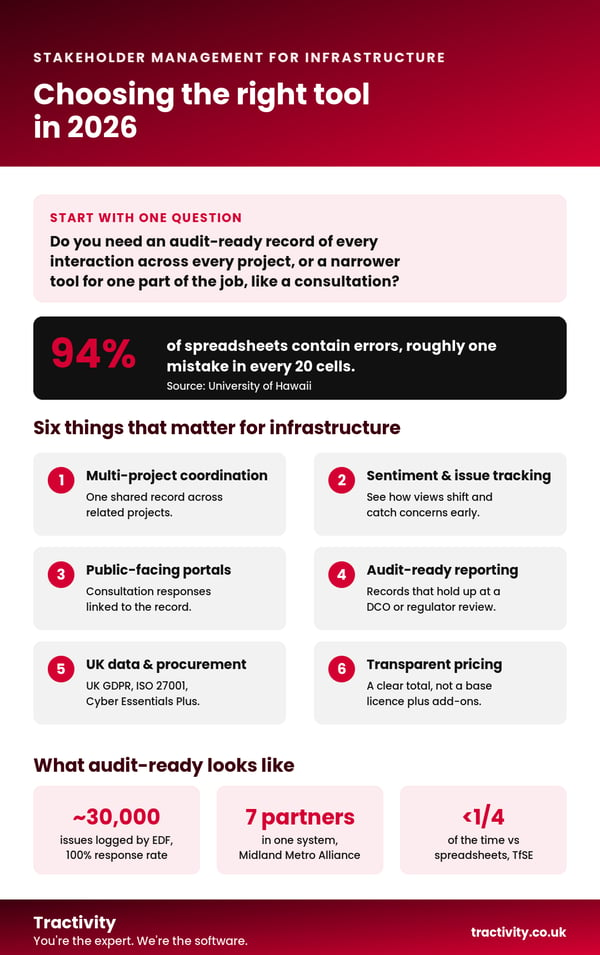 How to choose stakeholder management software for infrastructure:
the question to ask, the six criteria, and what audit-ready looks like in practice
The 7 top stakeholder management tools for infrastructure
1. Tractivity
Tractivity is the UK stakeholder relationship management (SRM) platform built for organisations running complex, regulated engagement across energy, water, transport and construction. It brings every interaction, email, meeting, call, survey response, event and feedback comment, into one date-stamped, exportable record, so the engagement evidence holds up under examination, FOI or regulator review.
It’s built for the way infrastructure programmes actually run, across multiple partners and projects. The Midland Metro Alliance coordinates seven alliance partners and several local authorities through one Tractivity instance, logging 2,500+ stakeholder engagements. EDF logged and tagged around 30,000 issues across Hinkley Point C and Sizewell C with a 100% response rate on stakeholder issues and 650+ events evidenced. Anglian Water manages 13,000+ stakeholders on the Cambridge Wastewater Treatment Plant Relocation, an NSIP inside a £10bn programme, with political engagement captured through the Mapolitical integration. National Grid runs 430+ users, and Transport for the South East reports spending less than a quarter of the time on stakeholder management compared with spreadsheets.
The Engage 360 portal hosts branded surveys, events and consultations with responses linked directly to stakeholder records, so there’s no manual re-keying and no gaps in the engagement history. Pricing starts from £9,495 a year, plus £500 a year for each additional user, with all core functionality included, no feature tiers, no onboarding fees and no charge for training or support. Implementation runs four to six weeks.
Features
- Multi-project stakeholder database, one source of truth across related projects, with continuity when team members change.
- Sentiment and issue tracking, tagged and monitored over time so trends and emerging concerns are visible across project phases.
- Engage 360 public portal, branded surveys, events and consultations feeding straight into the system.
- Email integration, targeted emails and newsletters saved automatically against stakeholder records.
- Audit-ready reporting, 150+ pre-built reports for regulators, planning inspectors and FOI responses, with full audit trails.
- UK accreditation stack, ISO 27001:2022, Cyber Essentials Plus, NHS DSPT and G-Cloud 14, hosted on Microsoft Azure UK South by default with European and US hosting available, and WCAG 2.2 Level A today with Level AA on track for 2026.
Pros
- Purpose-built for multi-project infrastructure engagement with regulatory-grade, defensible records.
- Named proof points across energy, water and transport, with transparent, all-inclusive pricing.
- UK-based support and a dedicated Client Success Manager, with four to six week implementation.
Cons
- Built for structured engagement programmes at scale, so a very small, informal community project may not use its full depth.
- As with any system of record, onboarding includes data migration and configuration, the onboarding team supports this.
2. Borealis
Borealis is a mature, enterprise-grade SRM with genuine analytical depth, particularly stakeholder mapping, segmentation, land management and grievance handling. Founded in Quebec, it has been owned by Irth Solutions of Columbus, Ohio, a TPG Growth portfolio company, since October 2025. It publishes nine industries, more than forty named client organisations across more than sixty countries, ISO/IEC 27001:2022 certification with the certificate published, and a product interface in five languages including French.
Features
- Stakeholder mapping by influence and interest, with network visualisation.
- Grievance tracking through a structured complaints process.
- Engagement activity logging against stakeholder records.
Pros
- Strong analytical and mapping depth for very large programmes.
- Dedicated grievance and land-management modules.
- More than forty named enterprise clients across more than sixty countries.
- ISO/IEC 27001:2022 certified, with the certificate published.
Cons
- A £14,550 one-time service fee plus £1,137 to £2,674 a user a year, per its own G-Cloud 14 pricing document.
- Modular pricing, so communications, SMS and complaint management arrive as separate cost lines.
- No UK data residency published. Their security page gives production servers as Canada, France and Australia, and their G-Cloud listing declares the European Economic Area and other locations rather than the United Kingdom.
- Their own G-Cloud listing answers "No" to both Cyber Essentials and Cyber Essentials Plus, and no NHS DSPT claim was found.
- Published support hours differ between their own sources: their help centre says 9am to 5pm Eastern Time, their G-Cloud listing says 9 to 5 UK time. Their UK page carries client logos but no UK case study.
3. Simply Stakeholders
Simply Stakeholders is a modern platform with AI-assisted sentiment, issue detection and summary features, and is a trading name of Darzin Software Pty Ltd. It publishes hosting regions including the UK and the EU on Microsoft Azure, a London address and a UK and EU support line, and names customers including Drax, Anglo American, Sasol, Ausgrid and Statkraft. It publishes no prices, so ask for a written quotation against your actual user count and tier.
Features
- AI-assisted analysis to surface patterns in stakeholder data.
- Stakeholder mapping and visualisation.
- Engagement activity logging against profiles.
Pros
- Clean, modern interface that demos well.
- ISO 27001 certified and SOC 2, hosted on Microsoft Azure with published UK and EU regions.
- AI Policy states customer data is not used to train their own or any third-party AI models, contractually enforced through Microsoft's Data Processing Addendum.
- AI features for sentiment, issue detection and summary.
Cons
- Their own published position on accessibility is that WCAG compliance is in progress, with no version or conformance level stated, and no accessibility statement or VPAT is published.
- Tiered pricing isn't published, and features Tractivity includes as standard sit in higher tiers.
- No G-Cloud listing was found in August 2026, no Cyber Essentials Plus and no NHS DSPT.
- Support hours and time zones are not published, so ask them to confirm UK working-hours coverage in writing.
- Their privacy impact assessment is stated against the Australian Privacy Act 1988 rather than UK GDPR.
4. EngagementHQ
EngagementHQ (Granicus) is a US community engagement platform focused on hosting public consultations and gathering citizen feedback, with consultation pages, surveys and interactive widgets. It’s a capable front door for inbound community engagement on a scheme.
Features
- Branded consultation pages for public engagement.
- Survey tools for gathering feedback.
- Engagement widgets such as polls, Q&A and idea boards.
Pros
- Strong public-consultation and community-feedback tooling.
- Multiple interactive engagement formats.
- Established global brand with a broad portfolio.
Cons
- Focused on consultation activity rather than full stakeholder relationship management. Granicus files it in its own product directory under "Sentiment & Feedback", and its own G-Cloud description calls it "the world's leading public consultation platform".
- What it publishes is a "Participant Relationship Management (PRM) database with audience segmentation", which is a participant record for outreach; no interaction logging against a named individual stakeholder and no commitment or obligation tracking was found in their published material.
- US-headquartered, though it has a London office, is G-Cloud 14 listed at £12,000 a unit a year, declares UK data storage and holds BSI-certified ISO 27001. Its own G-Cloud listing answers "No" to both Cyber Essentials and Cyber Essentials Plus, and API access is available on certain licence types only.
5. Syrenis SMART
Syrenis SMART is a legacy stakeholder management product from Syrenis, a UK-founded company now part of a group with its head office in Austin, Texas and a continuing UK office at Sci-Tech Daresbury in Warrington. Syrenis Limited remains a UK entity. Syrenis publishes a Home Office "Approval to Operate" and a connection to the Police National Network, and a solid security posture overall. Stakeholder mapping sits in the core product.
Features
- Tag-based stakeholder classification and mapping.
- Email and SMS broadcast, plus event planning.
- Document collaboration and a press office module (as paid add-ons).
Pros
- UK-founded, with a UK office, UK data residency available, and staff who can be cleared to SC for sensitive workloads. Their own G-Cloud filing lists data locations as United Kingdom, European Economic Area and other locations, with customer control over location, so confirm at contract.
- Cyber Essentials Plus and SOC 2 Type II, with a genuine government track record.
- Core stakeholder mapping included.
Cons
- Surveys, social, web content, press office and document collaboration are all chargeable add-ons, and support is metered in pre-paid blocks.
- ISO 27001 is on the older 2013 standard and its scope explicitly excludes services outside AWS, and hosting is AWS rather than Azure. No Welsh language support is published; we could find no statement either way, so ask them directly if you have Welsh Language Standards obligations.
- Syrenis de-branded SMART on 21 April 2026 as part of a company-wide brand relaunch. It no longer appears in their navigation, pricing or industry pages, their own Trust Center describes it as "our stakeholder management capability, which forms a small part of the broader Syrenis platform", and the company now positions entirely around consent and preference management. It is still listed and priced on G-Cloud 14 at £4,215 per user per year, so it is available, but treat it as a legacy product and ask about the roadmap before committing.
6. Jambo
Jambo is a stakeholder information management tool with a clean interface and Outlook and Gmail integration, headquartered in Edmonton, Canada and owned by the Silvacom Group, with further offices in Calgary, Dublin and Croatia. It publishes its Professional price openly, at approximately US$995 a month for up to a small number of users on an annual subscription, with Enterprise custom-quoted. Its published focus is North American natural resources and Indigenous relations.
Features
- Issue tracking for concerns raised across engagements.
- Communication logging for meetings, emails and calls.
- Reporting on engagement activity.
Pros
- Simple and quick for small teams to adopt.
- Email integrations.
- Issue and interaction logging in one place.
Cons
- No dedicated interest/influence mapping module (segmentation is via tags, custom fields and Esri maps); consultation surveys run through third-party integrations rather than a built-in tool; structured engagement planning is not part of the core product.
- Communication campaigns may sit outside the entry tier; confirm with the vendor
- One UK customer is publicly identifiable, and no UK case study is published. No G-Cloud listing was found in August 2026, and by their own account an application is in progress. Support hours are not published, so ask them to confirm UK working-hours coverage in writing.
7. Citizen Space
Citizen Space (Delib) is a UK consultation portal with a strong public-sector track record and a tight focus on publishing formal consultations, capturing responses and reporting on them. For teams whose immediate need is running a statutory consultation cleanly, it does that job well.
Features
- Consultation publishing and response capture.
- Structured consultation reporting.
- A recognised UK public-sector consultation format.
Pros
- Focused, reliable consultation publishing, with a new consultation activity type added in 2026 and First Pass Analysis AI rolling out through the year.
- The strongest published UK central government references in this list, including the Department for Education, DEFRA, DESNZ, MHCLG, Ofqual, National Highways, HM Courts and Tribunals Service and NHS Digital.
- UK company based in Bristol, G-Cloud 14 listed at £10,495 to £99,995 an instance a year, data storage declared as United Kingdom or EEA with customer control over location, ISO 27001 certified and holding Cyber Essentials.
- States its product is tested to WCAG 2.2 Level AA or above with an external accessibility partner.
Cons
- Ends at the consultation response, with no wider stakeholder relationship record.
- Publishes no interaction logging against a named individual stakeholder record and no commitment or obligation tracking; the nearest equivalent is the public "We Asked, You Said, We Did" function, which is transparency publishing rather than an internal obligation tracker.
- Usually needs pairing with an SRM for the full audit trail.
Comparison table
| Tool | Built for | UK-based / support | Public consultation portal | Commitment and obligation tracking | Pricing |
|---|---|---|---|---|---|
| Tractivity | Regulated UK infrastructure, multi-project | UK and EU working hours, UK team | Yes (Engage 360) | Yes | From £9,495 a year, all core functionality included. Engage 360 priced seperately |
| Borealis | Large land-access and grievance programmes | Help centre: 9am to 5pm ET; G-Cloud: 9 to 5 UK time | Grievance and feedback portal only | Yes, Professional tier and above | £14,550 one-time plus £1,137 to £2,674 a user a year (G-Cloud 14) |
| Simply Stakeholders | Stakeholder mapping and AI issue detection | Australia, with published UK and EU Azure regions; | Grievance portal and webforms only | Yes, Plus tier and above | Not published; per user, billed annually |
| Jambo | North American natural resources and Indigenous relations | Canada, Ireland and Croatia offices; support hours not published | No | Yes | From approximately US$995 a month (Professional); Enterprise on request |
| EngagementHQ | Public consultation, community feedback | USA, with London office | Yes | Not found | £12,000 a unit a year (G-Cloud 14) |
| Syrenis SMART (legacy) | UK central-government compliance | UK office; G-Cloud: 9:00-17:30 Mon to Fri | Webforms and surveys, as a paid add-on | Not published | From £4,215 a user a year (G-Cloud 14), add-on heavy |
| Citizen Space | Publishing formal consultations | UK | Yes | Not found | Per consultation/licence |
Based on each vendor's own published material and their Crown Commercial Service G-Cloud listings, reviewed August 2026. Verify current certifications, hosting arrangements, pricing and capabilities directly with each vendor before making a procurement decision.
What features matter most for infrastructure stakeholder management?
Infrastructure programmes create demands general CRM or survey tools don’t address. Rail extensions, offshore wind farms and water network upgrades run for years, so you need a system that keeps engagement continuity even as team members change.
The most important capability is multi-project coordination. Large programmes often span related projects across different local authorities, each with its own stakeholders and consultation duties. A shared stakeholder graph lets records carry across projects and prevents duplicate engagement, so the same councillor or community group isn’t approached twice by different teams.
Audit-ready reporting matters just as much. At a planning inquiry or DCO examination you have to show exactly how you engaged communities, what concerns were raised and how you addressed them. That needs complete, structured records, not scattered emails and spreadsheets.
How do you track stakeholder sentiment across long project lifecycles?
Sentiment shifts over the life of an infrastructure project. Someone supportive at the first consultation may turn opposed as details emerge, or the reverse. Understanding those shifts, and the issues behind them, helps you engage well and spot problems early.
Effective tracking needs more than a positive or negative flag. Tagging sentiment against specific issues and following it over time shows patterns across stakeholder groups and surfaces emerging concerns. That longitudinal view also underpins credible ESG reporting, where you need evidence of how you listened and responded over time, not just a count of consultation activities.
Why infrastructure teams choose Tractivity
For regulated infrastructure work, the deciding factors tend to be the same four: multi-project coordination, compliance, sentiment tracking over long lifecycles and audit-ready reporting.
Tractivity was built around exactly these, which is why it is trusted across UK energy, water and transport, including Anglian Water, National Grid, EDF, SSEN and the Midland Metro Alliance.
Every email, meeting note, survey response and event attendance is captured against the stakeholder record, creating the defensible audit trail that planning inspectors and regulators expect.
The Engage 360 portal feeds public consultations straight into that record, and the accreditation stack, ISO 27001:2022, Cyber Essentials Plus, NHS DSPT and G-Cloud, clears the procurement questions infrastructure buyers raise first. If you’re weighing up a system for a regulated programme, it’s worth seeing how Tractivity handles your engagement record.