


When working with project management or public consultation, there are four letters you need to consider that can save you time and effort: RACI.
RACI meaning
The RACI acronym stands for Responsible, Accountable, Consulted and Informed.
It serves as a straightforward tool that clearly lays out roles for project tasks and activities , avoiding confusion during any project.
Using a RACI chart can be a great basis to start your project management or consultation, whether you are a stakeholder manager, project manager or communications lead.
Why consider using RACI for project management?
Simply, it’s all about getting your internal teams in order before you even think about stakeholder management and communications software.
The RACI model provides clarity for all stakeholders involved in the project management.
It helps you document project roles and assign responsibilities while ensuring that all processes in your project go smoothly.
Throughout your public consultation or project, you'll work with multiple stakeholder groups, sending emails, attending meetings and working with independent bodies, so getting your internal processes organised can’t be underestimated.
Using a RACI matrix can be particularly useful for organisations in highly regulated sectors, for large-scale projects and when a wide range of stakeholders are involved.
Combining the RACI tool with a powerful stakeholder engagement and management system before you start your project can make your life easy.
RACI matrix template
The RACI matrix, also known as RACI chart, depicts owners in a project as shown in the example below. Your owners may be completely different, but the RACI ownership should be assigned across your team.
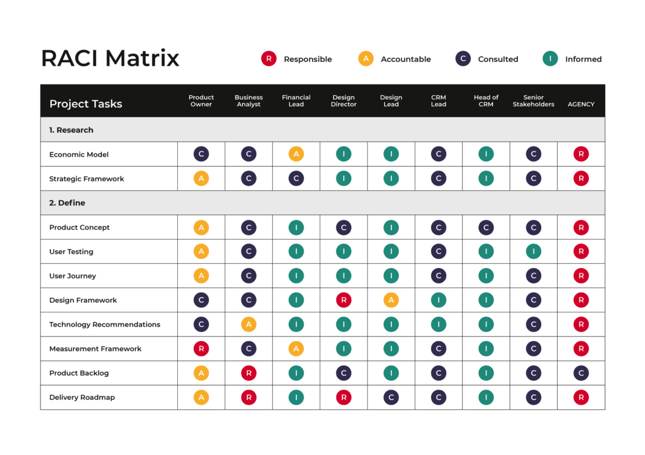
You can use a table as the one above or create a simple spreadsheet, adding the different tasks and activities and assigning a stakeholder to each one.
Use colour-coding for each one of the R, A, C and I letters to make it easier to identify the different responsibilities.
How to use a RACI chart
When implementing RACI in your project management, keep in mind that only one type of responsibility must be assigned per stakeholder, and there should only be one accountable per task.
Failing to consider these can complicate your RACI matrix and make it look confusing.
Now let's go over each one of the responsibility levels:
Responsible
This refers to the class of people that are responsible for the work - the action or implementation - in a particular aspect of the project process.
Just like any business, there are people that will need to take up roles, and there will be a range of people in charge of different processes.
By charting on the matrix the various responsibilities, you can be sure that nothing ever slips the net.
Many people will work on the actual communication to stakeholders. However, with RACI, you should have one person that hits send on a communication or one person who is responsible for updating data in line with GDPR.
Another benefit of the RACI model: it helps ensure there is never any task duplication.
Accountable
Accountability does what it says on the tin.
When it comes to a project, a consultation or general stakeholder engagement, there will be someone who has to be accountable at the end of the day.
This can be from task-related "did you send that survey?" through to a wider company sense of accountability – "have you met legislation around consultation?" or "have all stakeholders been engaged in the relevant time period?"
Those accountable in the RACI matrix world also have to make sure that those responsible deliver optimum quality.
That means that even if certain activities are done automatically, a person must be accountable for the task, which makes this a mandatory role.
On some tasks, the Responsible party may also serve as the Accountable one. However, as mentioned before, you must only have one Accountable person assigned to each task or deliverable.
When it comes to engagement or consultation, an SRM system can help you make your teams accountable.
With login data showing who was in the system, when, and what they did, you are not only aware of the team’s work on your project, but you can also pull in-depth reports that will help ensure that you are doing what you have set out to do.
Moreover, it is time-saving: with a proper system, reports can be created in minutes instead of days or even weeks.
Consulted
Naturally, being consulted is the key part of a consultation process!
However, when you are making a RACI matrix, this isn’t about the end-user being consulted.
It refers to the day to day or one-off problems with the work process, which may require internal consultation and preparation.
So, when these issues occur in the process, there is a person that handles them.
Documenting this is a great way to get ahead of any roadblocks, and also helps you inform your strategy for communications because you are planning against likely objections before you even start.
Informed
When you start a project or consultation, you need to be considering who it is that needs to be informed.
You have the stakeholder groups that you might need help to engage with.
And there are also the individuals who are involved in managing the work process and other internal stakeholders who need to be made aware if there are any issues or changes, and have to be up-to-date on any affair of the project.
When you map out a RACI matrix, consider all the people who are going to help you. Managers, PR departments – and then build on this to create your external consultation map of who you need to engage.
Creating a RACI chart
You can create your own stakeholder RACI matrix template following these steps:
-
Identify the processes involved in delivering the project and list them out in order of completion;
-
Map the stakeholders involved and also list them;
-
Assign those that will be responsible and accountable for tasks.
Without a proper structure that allows you to plan adequately, the work going into your project or public consultation will be tough.
But, with RACI, that burden is drastically reduced because you have the people in place to deal with a range of situations and the capability to reduce duplication of efforts.
It’s worth saying that without a platform or tool that will make it organized so that you can work properly, public consultations can become an administrative nightmare!
Project management streamlined
Manage your projects efficiently and keep your stakeholder engagement on track with a stakeholder management tool.Tractivity provides a complete suite of engagement and stakeholder management tools so you can focus on your project execution.
Contact us to find out how we can help you stay organised with your project and stakeholder management.