



Editor's note, August 2026: this article was written in April 2021, in the days immediately after the European Super League was announced. The proposal has not gone away since. In December 2023 the Court of Justice of the European Union ruled that UEFA and FIFA's rules requiring prior approval of new competitions breached EU competition law, and the project's backers have continued to develop revised formats. The stakeholder engagement lessons below still stand.
Stakeholders pressure and ESL: how to avoid this happening in your organisation
As the European football scene was shaken by the controversial European Super League plan, and with the countless comments on how it alienated its stakeholders, we spoke to Paul Rivers, chairman of Tractivity, to get his point of view on these events.
"They think it's all over...it is now!"
The announcement of a new European Super League managed to do what had been almost impossible for years, it united the other fourteen Premier League clubs, although you cannot help wondering what would have happened had they been on the invitation list, and it created an unlikely alliance of football fans and politicians.
All the more bizarre when you would be hard-pressed to find many positive opinions on the support from the UK government for Football Clubs during the Pandemic.
Less than 48 hours later, after political pressure, fan protests and condemnation from football's own governing bodies and broadcasters, all six English clubs had withdrawn and the competition did not launch.
What became apparent is that the owners of the six English clubs, most of whom are based outside the UK, went ahead without consulting the people the decision would most affect. Whatever the commercial logic, the proposal did not survive contact with the clubs' own stakeholders.
They totally and utterly forgot to consider all other parties who would be affected by this move – in other words they completely ignored their various cohorts of Stakeholders.
Now, this is not to denigrate fans as stakeholders – we have depressingly seen during COVID how empty football feels without fans - and it is heartwarming to see how even the fans of teams planning to break away voiced their opposition to the move.
That is to say that stakeholders DO matter, all of them. And the respective club owners have most certainly learnt it the hard way.
Where it went wrong
A stakeholder is a term to designate any individual, group or organisation that has an interest or is impacted by a business or organisation.
The clubs have clearly failed in engaging stakeholder groups and, at the very least, the following were NOT consulted:
- The fans
- Regulatory bodies
- Employees – not even the very players on whose abilities these clubs depend on – and probably the most expensive assets in the business
- Competitors – after all, competition is nothing without competitors, and the competitor Premier League clubs are also intertwined as shareholders
- The rest of the football pyramid – it was blithely believed that the rest of the pyramid could be bought through some promises of more cash – recent history would make this a barely believable outcome
And of course, there may be many more categories of stakeholders that would be affected.
If you take the not unreasonable view that stakeholders mattered to the economic interests of the DD you really couldn’t imagine a worse way of consulting that stakeholder base – or indeed not doing so.
Stakeholder buy-in is crucial for the success of any project or consultation, and consultation is based on core principles (the Gunning Principles). As our friends at the Consultation Institute have put, straight to the point:
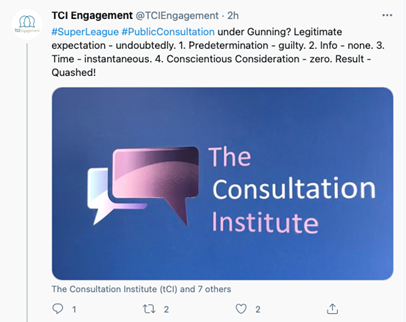
Stakeholder engagement & football
Football at the top is big business, and the need to work and engage with stakeholders has become crystal clear – so how could the clubs involved have done this better?
In a nutshell:
- Stakeholder mapping to identify all key stakeholders who should be consulted
- Clear communication & consultation with representatives of those affected, supporting proper stakeholder engagement
- Active stakeholder collaboration, supported by an engagement plan, and proper evaluation of the outcomes of the process
- A considered decision based on all the evidence, stakeholder feedback and submissions
Ultimately, the owners will probably walk away unbowed, and it remains to be seen what the legacy effect will be across the industry in years to come.
As the excellent online magazine The Athletic so eloquently put it: ‘Reprieve falls a long way short of redemption’.
Ensure your organisation doesn't make the same mistake
Spend time identifying your stakeholders across all levels of interest and influence, and get to know them. Learn their needs, issues and motivations so you can develop an effective communication strategy.
A carefully planned stakeholder engagement strategy will give you the chance to build a good relationship that will be reflected in the success of your project.
We at Tractivity are all about supporting organisations to deliver better outcomes, with stakeholder management and engagement software used by 112+ named UK clients across eight sectors.
Contact us to learn how we can help your organisation deliver positive results.
Contact us to learn how we can help your organisation deliver positive results.